Card Grading
Card grading is the process where professional third-party companies like PSA, BGS, and CGC evaluate a card's condition on a 1-10 scale and seal it in a tamper-proof case with the grade displayed. This authentication and condition certification can dramatically increase a card's value.
Two Major Players
Collectors Holdings
Collectors Holdings
Collectors Holdings

In 2025, PSA had 72 percent overall market share with 76 percent of sports cards and 69 percent of trading card games, and after acquiring SGC and Beckett, the parent company Collectors held about 80 percent market share in 2025. They keep that lead because PSA is the pricing benchmark for resale, and its scale plus retail submission channels drive more volume, which reinforces trust and liquidity.
CGC
Collectors Holdings
Collectors Holdings
In 2025, CGC had an 18 percent overall market share with 7 percent of sports cards and 25 percent of trading card games. CGC keeps that share because it is a major default choice for TCG grading, especially for Pokémon, and it has scaled volume through aggressive turnaround and submission options that keep collectors sending repeat bulk orders.
What The Process Looks Like
Order Entry
Authentification
Authentification

At order entry, each card is unpacked, matched to the submission form, assigned a unique order ID, and barcode-scanned into the system so it can be tracked through every step. Once the workflow is running smoothly, this typically takes about 30–60 seconds per card, depending on how clean the paperwork and packaging are.
Authentification
Authentification
Authentification
During authentication, the card is inspected under bright light and magnification to confirm it is genuine, unaltered, and matches the expected print and stock characteristics for that issue. This typically takes about 60–120 seconds per card, depending on the card’s rarity and any red flags that require closer checks.
Grading
Authentification
Encapsulation
During grading, the card is evaluated across the key condition categories (centering, corners, edges, and surface) under consistent lighting and magnification, and then a final grade is calculated and logged. This typically takes about 90–180 seconds per card, depending on the complexity of the set and how many defects need to be documented.
Encapsulation
Imaging & Database Entry
Encapsulation
During encapsulation, the finalized label is printed and verified, the card is placed into the holder, and a sealing press closes and locks the slab so it’s tamper-evident and ready for handling. This typically takes about 45–90 seconds per card.
Quality Control
Imaging & Database Entry
Imaging & Database Entry
During quality control, the slab and label are double-checked against the order record, the grade and serial/barcode are verified, and the holder is inspected for debris, scratches, or seal defects before approval. This typically takes about 30–75 seconds per card.
Imaging & Database Entry
Imaging & Database Entry
Imaging & Database Entry
During imagery and database entry, the slabbed card is photographed (front/back, plus any needed close-ups), the images are linked to the card’s unique ID, and the full record is saved to the database for tracking, verification, and customer display. This typically takes about 60–150 seconds per card.
How Many Card Are Graded

Throughput
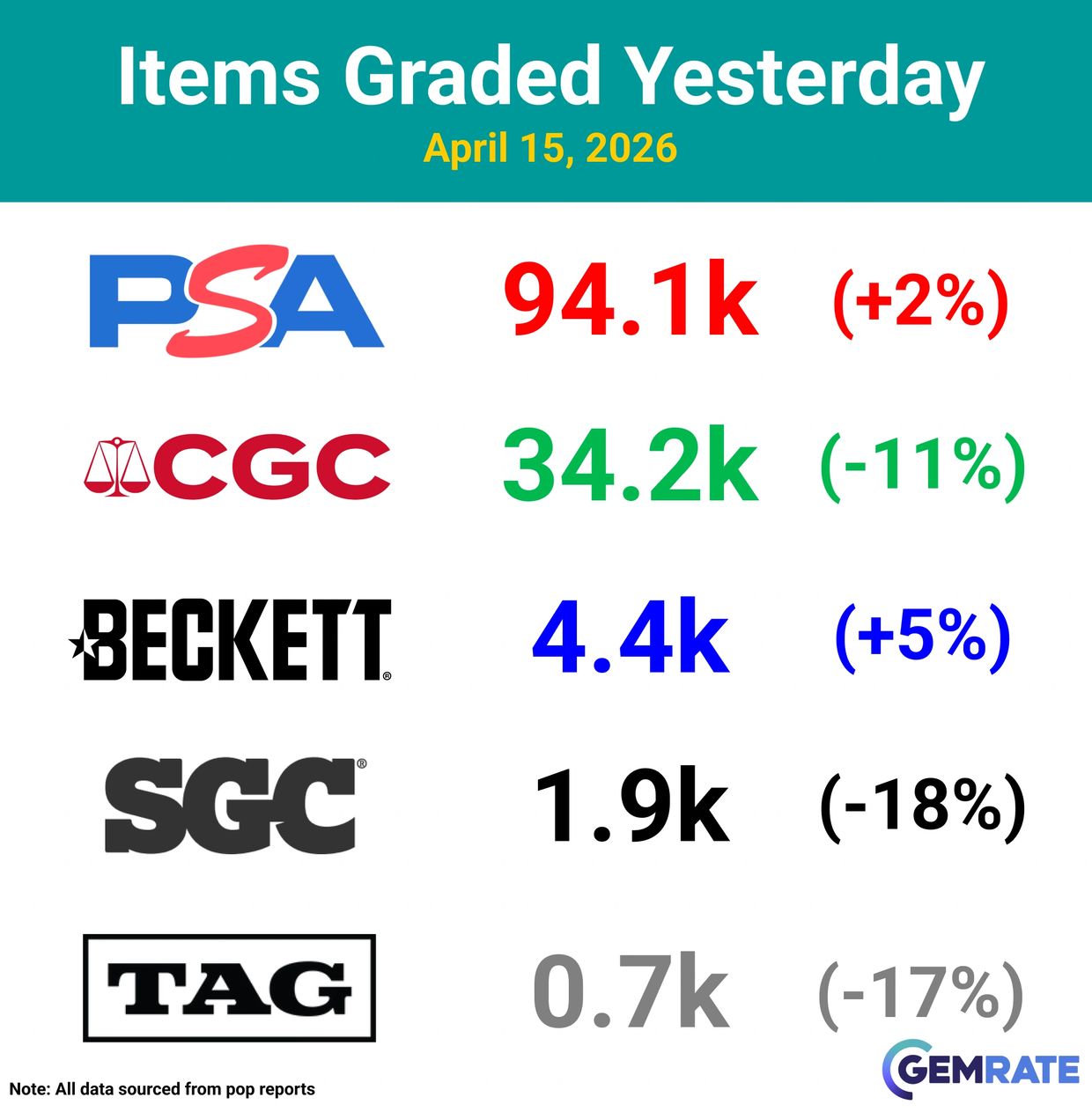
Across the major third-party grading companies, roughly 26.8 million cards were graded in 2025, up from about 20.0 million in 2024, based on GemRate-tracked volume. In 2025, PSA accounted for about 19.26 million (71.8%) and CGC about 4.92 million (18.4%), with the rest split among other graders (reported by Sports Illustrated).
Profitability
In fiscal 2020, Collectors Universe (then the parent of PSA) reported $78.9M revenue and $14.1M operating income—about an 18% operating margin. If a top grader maintains similar efficiency while charging today’s posted per-card prices (often $40+ for common tiers), scaling that kind of margin over vastly higher throughput implies hundreds of millions in potential annual revenue and meaningfully higher operating profit versus 2020.
Importance
The grading industry is important because it standardizes authenticity and condition, which builds trust and reduces disputes in a market where tiny defects can change value, and it boosts liquidity by giving buyers and sellers a shared benchmark. For example, Luka Dončić’s 2018 Panini Prizm #280 shows how big the spread can be: PSA’s auction-price tracker lists a most recent PSA 10 at $1,425 versus a most recent PSA 9 at $511.50 for the same card.